Mycorrhizal strategy of non-native plants varies with biome and disturbance
Nature Ecology & Evolution, 2026
Cazzaniga, S.G., Lauber, T., van den Hoogen, J., Beaury, E.M., Bueno, C.G., Bever, J.D., Damasceno, G., Catford, J., Lenoir, J., Martin, A., Mori, A.S., Novakovskiy, A., Gutiérrez, A.G., González-Robles, A., de Gasper, A.L., Moles, A., Stanisci, A., Csecserits, A., Jentsch, A., Kuzemko, A., Perea, A.J., Nerlekar, A., Munje, A., Güler, B., Jiménez-Alfaro, B., Hérault, B., Pinho, B.X., Baraloto, C., Rossi, C., Hending, D., Laughlin, D.C., Rogers, D., Schellenberger Costa, D., Thakur, D., Uogintas, D., Chacón-Madrigal, E., Alvarez-Davila, E., Weiher, E., Thomas, E., Gonçalves, F., Rodrigues, F., Sabatini, F.M., Schurr, F.M., Essl, F., Zizka, G., Bonari, G., Swacha, G., Chen, H.Y.H., Bruelheide, H., Ford, H., Wang, H.-F., Biurrun, I., Aubin, I., Dembicz, I., Willie, J., Altman, J., Svenning, J.-C., Lichstein, J.W., Moeslund, J.E., Dolezal, J., Cornelissen, J.H.C., Hunter, J., Messier, J., Dengler, J., Homeier, J., Orwin, K.H., Korznikov, K., Van Meerbeek, K., Macía, M.J., Schmidt, M., Varricchione, M., Carlucci, M.B., Spasojevic, M., Giorgis, M.A., Chytrý, M., El-Sheikh, M.A., Hatim, M.Z., Kraft, N.J.B., Mohanbabu, N., Phillips, O.L., Reich, P.B., Pielech, R., Arasa-Gisbert, R., Guarino, R., Testolin, R., Tarifa, R., Mukul, S.A., Phartyal, S.S., Schmitt, S., Haider, S., Dziuba, T., Domingues, T., Liu, U., Golub, V., Silva, V., Fontana, V., Vandvik, V., Kissling, W.D., Stančić, Z., Winter, M., Crowther, T.W., Delavaux, C.S.
Abstract
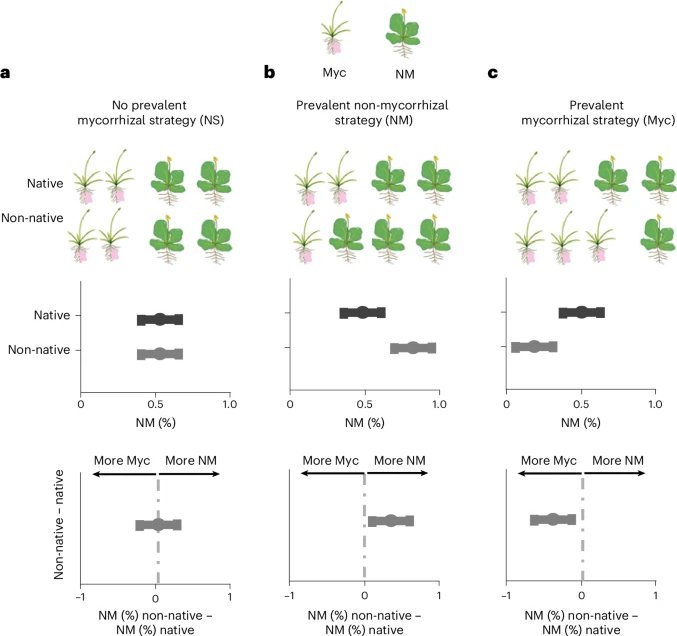
Predicting which non-native plant species will become established and where is critical for conserving and managing biodiversity. Theory suggests that the mycorrhizal strategy of non-native plants may predict their establishment success. Here we combine a global dataset of 440,788 vegetation plots with data on plant native status and mycorrhizal type to assess mycorrhizal strategy of non-native plants. The mycorrhizal strategy of non-native plants varies strongly across biomes. Across grassland and desert biomes, non-native species are more frequently non-mycorrhizal than native species, whereas in other biomes non-native species are more likely to be mycorrhizal, most commonly arbuscular-mycorrhizal. Disturbance type and intensity are key predictors of mycorrhizal strategy of non-native species, as mycorrhizal species are favoured by landscape modification and non-mycorrhizal species by natural and human-caused disturbance events. Facultatively mycorrhizal species are consistently under-represented among non-native plants compared with natives, suggesting that symbiotic flexibility does not confer an advantage for non-natives as previously expected. Our study shows that non-native mycorrhizal strategy varies across biogeographical contexts and disturbance, highlighting the need for region-specific prevention and management approaches to plant species introductions.
Link: https://doi.org/10.1038/s41559-026-03144-9