Divergent responses of endemic and non-endemic plant species to climate change in South American Lomas ecosystems
Abstract
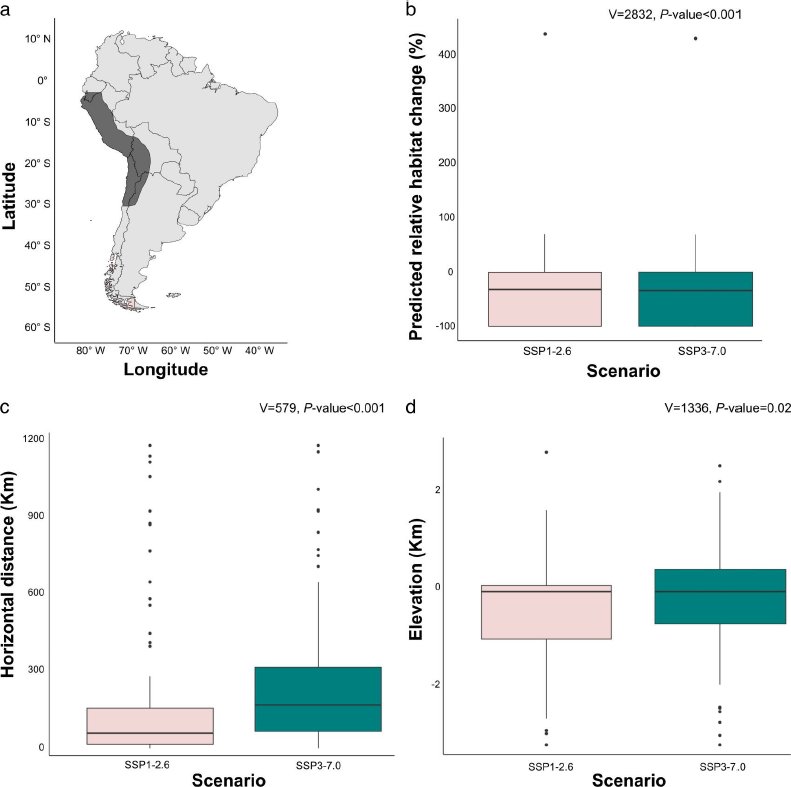
The Lomas ecosystem, situated along the arid coast of Peru, is a key refuge for biodiversity, characterized by unique vegetation adapted to dry conditions and strongly influenced by seasonal winter fog. However, this ecosystem faces serious threats from climate change, including shifting rainfall patterns, increased aridity and habitat degradation, further compounded by urban expansion. Using species distribution models, we projected future habitat suitability of plant species across a broader region encompassing the Lomas ecosystem, under two climate scenarios (SSP1-2.6 and SSP3-7.0). Our results showed significant habitat shifts, with projected habitat loss increasing from ∼31% under SSP1-2.6 to ∼33% under SSP3-7.0. Species responses varied by endemism and elevation. Endemic species distributions tended to shift farther and upslope, while non-endemic species generally shifted downslope, increasing exposure to degraded lowland environments. High-elevation species are predicted to undergo the greatest downslope displacements and habitat reductions, whereas low-elevation species remained more stable or shifted slightly upslope under SSP3-7.0. These patterns highlight the critical role of localized factors—such as fog dynamics, topographic constraints and urban pressures—in shaping future species distributions. Our findings emphasize the urgency of developing spatially explicit conservation strategies and improved modeling frameworks that account for rare species, fine-scale environmental data and species-specific ecological responses to ensure the long-term resilience of the Lomas ecosystem.