Trade-Offs in Soil Microbial Carbon Economic Strategies Under Agricultural Management Practices: A Global Meta-Analysis
Abstract
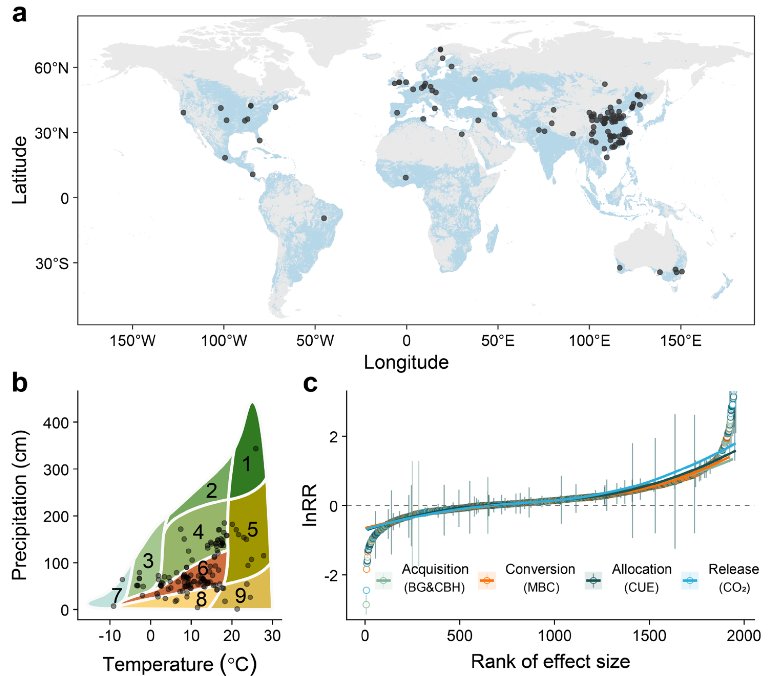
Agricultural management profoundly influences soil carbon (C) dynamics by regulating microbial processes that drive C cycling. However, a comprehensive and globally integrated understanding of these mechanisms remains limited. In this study, we defined soil microbial carbon economic strategies (MCES) as four linked processes, including acquisition (β-glucosidase and cellobiohydrolase activities), conversion (microbial biomass carbon), allocation (microbial carbon use efficiency), and release (soil CO2 emissions). Based on 1957 observations from 140 field experiments, this study evaluated the responses of MCES to agricultural management and identified their underlying drivers at the global scale. Results showed that straw return significantly increased microbial C acquisition, conversion, and release by 27.0%, 55.1%, and 94.4%, respectively. Inorganic fertilization significantly increased microbial C allocation and release by 24.1% and 23.2%, respectively. By contrast, conservation tillage and organic fertilization significantly enhanced microbial C acquisition and conversion by 267.7% and 44.8%, respectively, without significantly increasing microbial C release. Crop diversification (rotation and intercropping) and vegetation restoration mainly increased microbial C allocation, as reflected by microbial carbon use efficiency, by 42.5% and 28.6%, respectively, indicating a shift toward more efficient microbial use of assimilated C rather than a broad stimulation of C acquisition, conversion, or release. Management effects on MCES were strongest in topsoil and neutral soils, crop type and climate further modulated these responses, with C4 crops favoring microbial C conversion and allocation, and arid regions showing stronger increases in microbial C allocation and release. Significant increases in microbial C allocation were mainly detected using stoichiometric modeling and 18O methods rather than 13C methods. Globally, predicted microbial C acquisition increased with latitude, whereas microbial C allocation and release showed localized hotspots. These findings reveal contrasting responses among MCES and highlight organic fertilization, reduced soil disturbance, and diversified cropping systems as promising practices for enhancing microbial C retention while limiting potential C losses in agricultural soils.